One of the most successful new Australian plays of recent years, Suzie Miller’s Prima Facie began life in 2019 as a modest one-hander in the 110-seat SBW Stables Theatre in Kings Cross. The play was instantly recognised as deserving of a wider audience, and a 2020 season was initially scheduled for both Melbourne and Sydney but had to be cancelled due to COVID-19. The show was re-staged in Sydney in 2021, but it would be a few more years before Melbourne audiences got to experience Griffin Theatre’s award-winning production, directed by Lee Lewis and starring Sheridan Harbridge, as part of MTC’s 2023 mainstage season. In the intervening years, the play was produced in the West End with Jodie Comer in the lead, where it picked up the 2023 Olivier Award for Best New Play (and Best Actress for Comer), later delivering Comer a Tony Award on Broadway. Prima Facie has since been translated into dozens of languages, taught in law schools, and debated in legal circles. A feature film with ‘Wicked’ star, Cynthia Erivo, playing the lead role is currently in post-production.
Prima Facie follows Tessa Ensler (Harbridge), a highly successful criminal defence barrister who has built her reputation on mastering the male-dominated, adversarial rules of the courtroom, particularly in sexual assault trials. She is brilliant, charismatic and ruthless, but she can also be arrogant, and dismissive of those around her as evidenced by her snarky impersonations of everyone from the judge, to her own family. Embarrassed by her working-class roots, she has come to view the legal system as a way to dominate others, particularly the privileged “thoroughbreds” she delights in defeating.
Miller describes Tessa as a “young blood criminal barrister addicted to the game of law, bursting with social justice and fighting what she believes is the good fight”. But the Tessa we see, initially at least, appears far less noble or idealistic. Her courtroom persona, as she recounts in the opening scene, has been carefully cultivated to lure opponents into the fatal mistake of underestimating her. The moment she senses a witness has dropped their guard, she unleashes the killer questions – “Bang. Bang. Bang bang … You fucking idiot. You thought you had this. But here I am.” On her way out of the courtroom, her internal monologue is less about justice, and more about triumph. “RESPECT. Power. Today I was a winner. Today, I came first.”
When a burgeoning office romance turns into sexual assault, the tables are turned and she finds herself on the opposite side of the legal process, one which is markedly different from the one she has spent her career navigating. Dragged through the court system this time as a complainant, and despite knowing its myriad traps, she is nonetheless powerless to avoid the same fate as her previous combatants. By the final scenes, Tessa’s earlier hunger to dominate has been replaced by an almost desperate need simply to be heard.
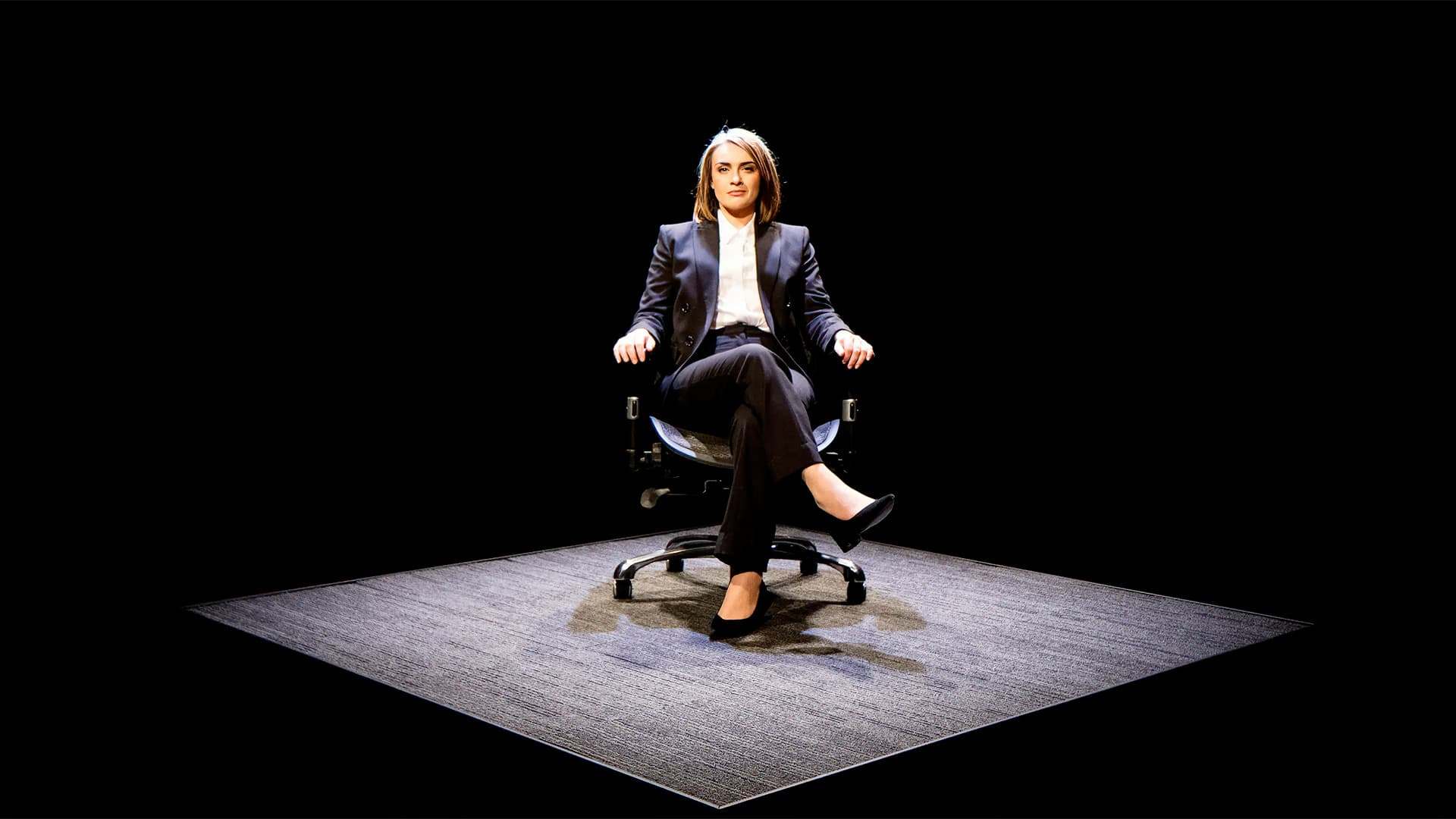
Much has been made of Sheridan Harbridge’s extraordinary solo performance, and rightly so. She is excellent as Tessa, moving deftly through a wide spectrum of emotions, from arrogance and feigned modesty to rage and confusion. Harbridge is more self-consciously performative in the early scenes before settling into something more authentic and raw as the play unfolds. Aided by the sparse staging – a chair in a spotlight – the audience is drawn toward the nuances of the text and performance. This stripped-back approach also sharpens the play’s critique of legal process. Miller demonstrates clearly how, in reaching its determination, the court demands a surgically precise account of events and motivations. Yet the absurdity of such a requirement becomes starkly apparent when set against the confusion of lived reality and deliberate legal obfuscation. It is in these incremental distortions – rather than in any overt statement of principle – that the play is at its most persuasive.
Yet while the emotional trajectory of the play is clear, its final movement is less convincing dramatically. Although two years have passed within the play, Tessa’s concluding speech still arrives somewhat abruptly, shifting the work away from psychological realism and into something more didactic.
The arguments at the heart of Prima Facie are not new. The proposition that the adversarial legal system is structurally weighted against complainants in sexual assault cases – and, more specifically, against women – has been extensively argued long before Miller’s play reached the stage. But their familiarity makes them no less important, nor any less worthy of continued discussion.
Event details
Griffin Theatre Company and Andrew Henry presents
PRIMA FACIE
by Suzie Miller
Director Lee Lewis
Venue: Comedy Theatre | 240 Exhibition St, Melbourne VIC
Dates: 20 – 31 May 2026
Bookings: primafacieplay.com.au